Overview
As UX designer on Helios, an agentic AI platform for data center operations built by Hanwha Q CELLS in partnership with Microsoft, I designed the interface layer that lets two different roles — an on-site Operator and a supervising Ops Manager — work alongside an AI copilot that triages, recommends, and explains itself, while a human stays the final decision-maker on anything that touches live infrastructure.
Introduction
Data center teams were running EPMS, BMS, and DCIM tools that never talked to each other, so understanding fleet health meant stitching together alarms, telemetry, and tribal knowledge by hand. Helios set out to unify that into one conversational, AI-assisted view — but that meant designing for a harder problem than a dashboard refresh: how much should an AI agent be allowed to say and do inside a system where mistakes carry real cost and safety consequences?
Problem
How might we let operators and managers trust an AI agent's recommendations enough to act on them inside live, safety-critical infrastructure — without demanding they audit every line of reasoning, and without stripping away their ability to override, question, or stop it the moment something doesn't add up?

Research
Interviews and shadowing across two personas — Operator and Ops Manager — plus a competitive audit of adjacent platforms (Schneider EcoStruxure, Vertiv, ABB, Emerald AI, Phaidra) surfaced the same gap everywhere: alerts, not answers. Full research detail is in the presentation deck.
"
An alarm without a next step just gives you one more thing to track.
Ideation
Explored where the AI's voice should live — a separate assistant tab lost the moment it mattered most, so it moved into an always-visible panel that narrates its own reasoning alongside the data it's reasoning about. Also tested gauges vs. fill bars for status at a glance, landing on fill bars for faster scanning under time pressure. Full exploration in the presentation deck.
Solution
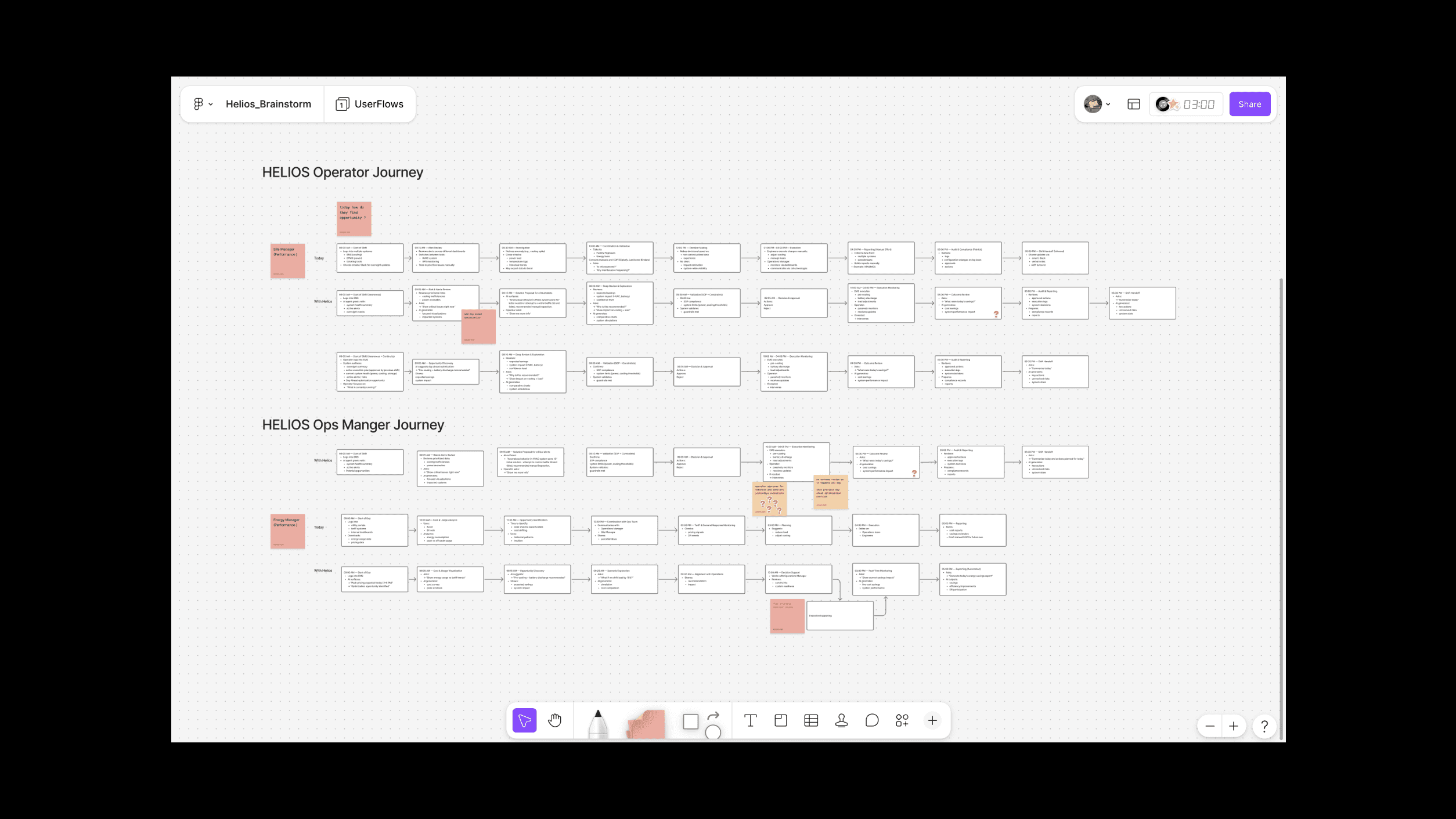
1. One trust model, two altitudes of decision. The Operator lands on a severity-ranked queue of alarms, each already paired with the AI's suggested fix (e.g. "bring CH-3 online and fail the Hall A loop over") — a reactive, ground-level view. The Ops Manager instead lands on a fleet-wide health overview and reviews the AI's proactive case for a cost-saving change, like pre-cooling a data hall ahead of a price peak — a supervisory, portfolio-level view. Same underlying agent, same trust pattern, different scope of judgment.
2. The optimization card, not a black box. Every AI-proposed change surfaces as a card with a Drivers tab (why now — tariff pricing, ambient temperature) and an Actions tab (what changes — setpoints, staging, hour-by-hour projected effect), with the copilot narrating its reasoning in plain language alongside. Approve or reject sits one click away, but never before the reasoning is visible.
3. Approval and execution are deliberately separate roles. The Ops Manager approves; the Operator carries it out. Helios doesn't have write access into the building management system by design, so an approved plan exports for the operator to apply and manually confirm — a real, physical human-in-the-loop checkpoint rather than a UI formality.
4. An audit trail that closes the loop. Every approved action is traceable: plan created, approved, executing, applied, and confirmed by telemetry once the system converges. That record is what makes it safe to hand more decisions to the AI over time.


Impacts
Validated directly with both Operator and Ops Manager stakeholders. The core win ties straight back to the original problem: root-cause diagnosis that used to take operators days — piecing together fragmented EPMS, BMS, and DCIM data by hand — now collapses to minutes inside a single conversational view. Helios is currently moving toward broader rollout across the fleet.